Episode Summary
The Hook
What should we take ownership of once we know the fuller truth about the histories we’ve inherited?
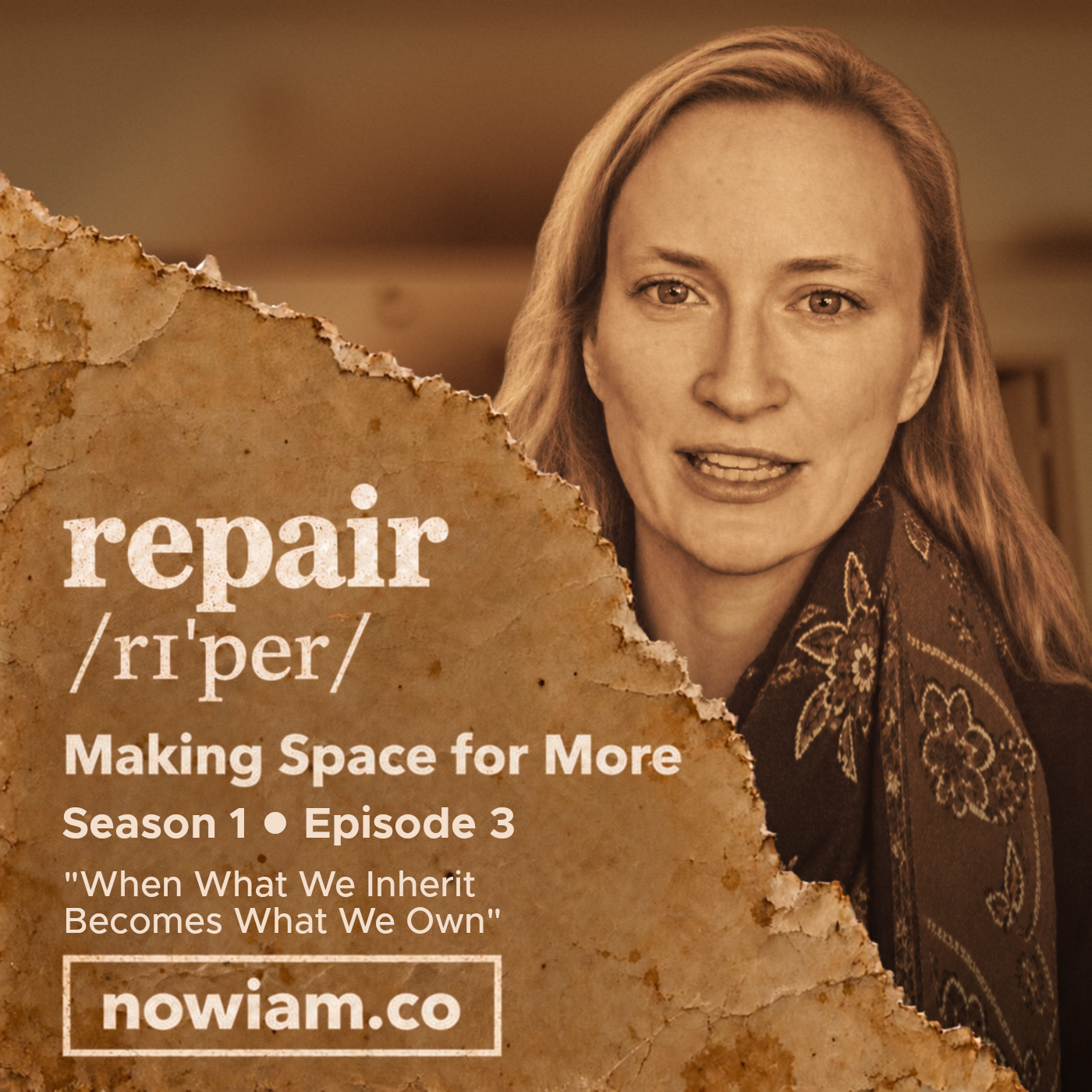
In this episode of Repair: Making Space For More, Sammy Rangel sits down with Elizabeth Woodson, founder of Reckon With, for a conversation on a multigenerational reckoning with slavery and its legacy today. The central question – does repair become less about a single moment of reconciliation and more about how we choose to live, relate, and show up differently because of what we now know?
In This Episode, We Cover:
- What it means to inherit a history you didn’t create — but can no longer unknow. Elizabeth reflects on discovering the fuller story of the Woodson family, whose history in America reaches back more than 400 years and encompasses both white Woodsons who enslaved people and a Black Woodson lineage that includes Dr. Carter G. Woodson, the pioneering historian whose work gave rise to Black History Month.
- Why acknowledgment and apology are beginnings, not endpoints. The Woodson family’s story includes a public apology and reconciliation ceremony — but the deeper work happened through years of relationship, presence, truth-telling, and an ongoing recognition that interpersonal reconciliation does not erase structural harm.
- How knowing changes responsibility. Elizabeth considers the question that now shapes much of her life and work: once we understand the harms we are connected to, what does that knowledge ask of us in the present?
- Why repair has to happen close to home. After years working on racial justice and racial terror, Elizabeth began looking more closely at the relationships, communities, and institutions immediately around her — and at the ways distance and avoidance can become their own barriers to change.
- How to hold truth and relationship at the same time. What does it look like to stay in relationship without minimizing harm, abandoning conviction, or requiring agreement first?
Meet Our Guest
Elizabeth Woodson: Founder, Reckon With
Elizabeth Woodson is the founder of Reckon With, a peer-support community for white Americans working to better recognize and interrupt racism in themselves, their families and friendships, and the institutions and communities they are part of.
Her path to this work has included supporting survivors of sexual violence at Stanford University and researching the history of racial terror with the Equal Justice Initiative. She founded Reckon With in 2021 — before fully understanding how intimately her own family history intersected with the history she had spent years studying.
That understanding became deeply personal as Elizabeth learned more about the Woodson family’s history in America: a history that includes enslavement and land colonization, but also another Woodson lineage that includes Dr. Carter G. Woodson, the renowned historian, author of The Mis-Education of the Negro, and one of the founders of the organization now known as the Association for the Study of African American Life and History.
Today, Elizabeth’s work explores what happens when awareness becomes responsibility — and how repair moves from something we believe in to something we practice in our families, neighborhoods, institutions, and everyday relationships.
Connect with Elizabeth
Reckon With
Learn more about Reckon With and opportunities to participate: reckonwith.org/joinus
Episode Timestamps
- 00:00 – Welcome to Repair: Making Space For More
Introducing Elizabeth Woodson and two very different journeys of repair. - 04:23 – The Woodson Family Story
A family history stretching back more than 400 years — and the stories that were, and were not, carried forward. - 23:03 – Two Woodson Histories
Dr. Carter G. Woodson, the Black Woodson family, and a history that existed alongside — but largely apart from — the story Elizabeth’s white family understood about itself. - 24:56 – When History Becomes Personal
Elizabeth reflects on learning the fuller story of her family and realizing how closely it intersected with the work she had already devoted her life to. - 37:55 – Bringing Repair Closer to Home
Why some of the hardest work may exist not in distant systems, but in our own families, friendships, neighborhoods, and communities. - 53:59 – Outro/Close – Sammy and Christy
Resources Mentioned in This Episode
- The Woodson Family Story — NPR Code Switch: NPR explores the intertwined histories of the Black and white Woodson families, the reconciliation efforts that began decades ago, and the complicated question of what healing can — and cannot — accomplish across generations.
- “Buses on a River: On the Infrastructure White Liberals Have Failed to Build” — Nonprofit Quarterly: In this essay, Elizabeth writes about moving beyond political action at a distance and investing in the relationships, organizations, and civic infrastructure of the communities where white Americans actually live.
- Association for the Study of African American Life and History (ASALH): Dr. Carter G. Woodson helped found the organization now known as ASALH in 1915. Today, it continues his work to research, preserve, interpret, and share Black life, history, and culture and carries forward the legacy that ultimately helped establish Black History Month.
- Reckon With: Founded by Elizabeth Woodson, Reckon With offers peer support for white Americans who want to become better at recognizing and interrupting racism in themselves, their relationships, and the institutions and communities they are part of. Learn more or participate: reckonwith.org/joinus
- Coming to the Table: For people exploring family histories connected to enslavement — including descendants of enslavers and enslaved people — Coming to the Table provides community, genealogy resources, local groups, truth-telling, relationship-building, racial healing, and opportunities for action.
- Historical Genealogy of the Woodsons and Their Connections: Compiled by Henry Morton Woodson and published in 1915, this extensive genealogy documents the white Woodson family and offers a window into how the family historically recorded and represented its own story. The volume also includes the image of the Woodson family rifle discussed in connection with ongoing efforts to change how that history is represented at the Virginia Museum of History & Culture.
Join the Conversation
Subscribe & Review
If this conversation stayed with you, please continue checking this space for new episodes. We’ll be available in Apple Podcasts and Spotify in early 2027.
About This Podcast
Repair: Making Space For More explores what it means to live honestly and authentically after harm—whether we caused it, experienced it, nearly caused it, or inherited its consequences.
Through deeply human stories, we examine accountability without dehumanization, responsibility without shame, and the difficult work of making space for something beyond what can come next after harm.
Connect with the Hosts
Follow Sammy Rangel: linkedin.com/in/sammyrangel
Follow Christy Grace Provines: @cgpnyc | IG and linkedin.com/in/christygraceprovines
Visit NOW I AM_: nowiam.co | Creating a Culture of Repair in America
Share Your Thoughts
How do we live responsibly with the versions of ourselves we no longer want to be?
What does repair look like when there is no act to undo, but there is still something to reckon with?
How do we hold two realities at once and move forward with repair?
Join the Community and Tell us a story of Repair in your life at nowiam.co/community
Production
Christy Grace Provines | Creative Director and Co-Host
Sammy Rangel | Lead Host
Tim Shores | Producer
Matt Lolich | Post-Production Editor